Travelling With Children and Spouse
Children with different surnames, consent letters, and what to carry when the family holds two nationalities.
Yes. Every child, even a newborn, needs their own passport for international air travel. The rules can feel like a maze, and a simple mistake can lead to a cancelled trip, lost money, and immense stress at the airport. This guide cuts through the bureaucracy. We'll give you a clear checklist, focusing on U.S. requirements, and pay special attention to the hurdles parents in complex custody situations or with different nationalities might face. We'll also touch on rules from countries like Australia for context.
What Do I Need to Apply for a Child's Passport?
First things first: the application. The requirements for a child's passport are intentionally stricter than for an adult's, a measure designed to prevent international child abduction. The standard rule, laid out in U.S. law under 22 C.F.R. § 51.28, is that both parents or legal guardians must show up in person with the child at a designated acceptance facility. This forces a moment of cooperation, which can be a significant hurdle for separated parents. You'll need a specific checklist of items: proof of the child's U.S. citizenship (the original birth certificate, not a copy), documents proving your parental relationship, your own government-issued IDs, and a compliant passport photo.
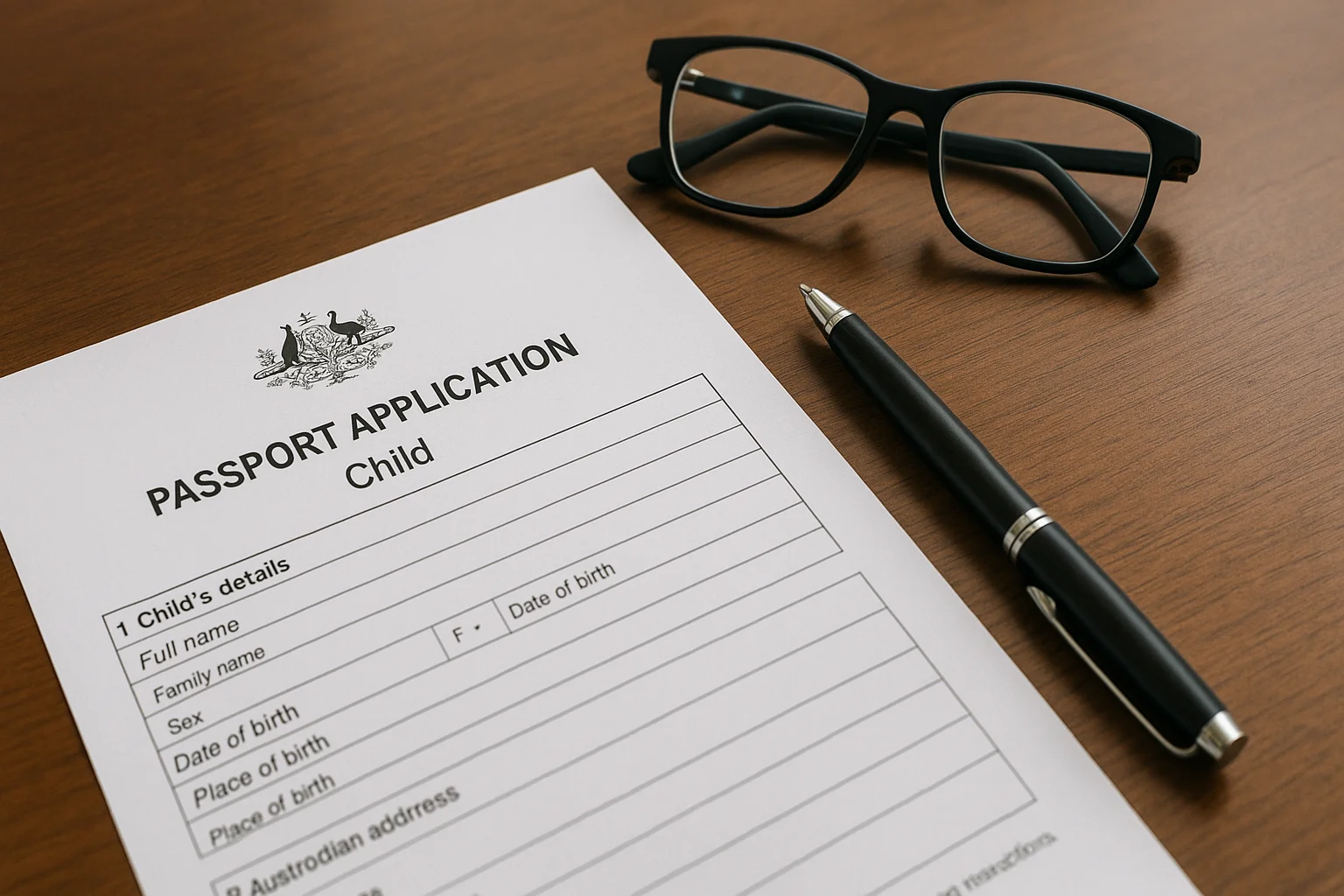
Child passport application
The "child passport application" is the formal process for getting a U.S. passport for a citizen under 16. It's more than just paperwork. You have to gather specific documents, fill out the right form, and physically appear with your child. Your goal is to prove the child's identity and citizenship, and, most critically, to establish clear parental consent. All these documents are handed to a passport acceptance agent who will verify your identity and witness your signature.
DS-11
Form DS-11 is the key. This is the U.S. Department of State's official Application for a U.S. Passport for a new applicant. You can fill it out online and print it, or get a paper copy, but it cannot be submitted online. Here's the critical part: do not sign the form. Wait. You must sign it in front of the passport acceptance agent, who has to witness the act. Signing it at home will invalidate the entire application, forcing you to fill it out all over again at the facility.
Passport facility near me
You can't just mail in a first-time child passport application. You, the other parent, and the child must submit it together, in person, at a designated passport acceptance facility. These are often tucked inside U.S. Post Offices, clerks of court, public libraries, or other local government offices. To find one, use the U.S. Department of State's official online Passport Acceptance Facility Search Tool.
Passport appointment
Don't expect to just walk in. Most acceptance facilities now operate by appointment only. During peak travel seasons, getting one can be tough, so it’s vital to schedule an appointment well in advance of your trip. You can typically book online through the facility’s own system (like the USPS website) or by calling them directly. Plan ahead. This simple step can prevent a major delay right at the start.
How Do I Get a Child Passport with Only One Parent Present?
While the two-parent consent rule is the bedrock of child passport security, U.S. law anticipates situations where one parent simply can't be there. These exceptions, however, are strictly defined and demand official documentation. The goal is to allow legitimate travel while still guarding against parental abduction.
How to get a child passport with one parent absent
If appearing with the other parent isn't possible, you have three main paths. First, the absent parent can provide a signed and notarized consent form. Second, if you have a court order granting you sole legal custody, you can present that document. Third, in rare "special circumstances"—like the other parent's location being completely unknown—you must submit a detailed, signed statement explaining precisely why their consent cannot be obtained.
What is Form DS-3053?
Form DS-3053, the Statement of Consent, is the specific legal document that makes the first option possible. The non-applying parent fills out this form, signs it in front of a notary public, and must provide a clear photocopy of the front and back of the exact government-issued ID they showed the notary. This form has an expiration date. It's only valid for 90 days after being notarized, which means you have a three-month window to get your complete application submitted. Miss that window, and you'll need a new, freshly notarized form.
How Much Time Do We Need Before Our Trip?
Timing is everything. Passport processing times are lengthy and are never guaranteed, so you need to build in a buffer. The U.S. Department of State provides estimates for routine and expedited services, but these fluctuate with demand. Right now, routine service is estimated at 6-8 weeks, with expedited service taking 2-3 weeks. Crucially, these timelines don't include mailing time, which can add another week or two on both ends.
Other countries have similar waits. For instance, the Australian Passport Office tells parents to allow at least 6 weeks for a standard child passport application. While they do offer a priority service for processing in as little as two business days for a hefty fee, this is not available for complex cases. Any application submitted without full parental consent or a relevant court order has no guaranteed timeframe; it gets flagged for special, manual assessment that can easily add 3–4 weeks or more to the process.

Passports for kids
A key detail many parents miss is the validity period. A passport issued to a child under 16 is valid for only five years. Adult passports are good for ten. This shorter duration is another safeguard, ensuring the photo stays reasonably current as the child grows. It also means parents need to be diligent about checking expiration dates and planning for renewals far ahead of any planned international travel.
How long do you have to have left on a child's passport to travel?
This catches so many people off guard. Many countries enforce the "Six-Month Validity Rule," meaning your child’s passport must be valid for at least six months *after* your planned departure date from that country. An airline can—and will—deny boarding if your passport doesn't meet this rule for your destination. Before you book anything, check the specific entry requirements on the destination country's official embassy website.
What if We Have a Unique or Difficult Family Situation?
The strict consent rules aren't arbitrary; they're designed to comply with international treaties like the Hague Convention on the Civil Aspects of International Child Abduction. They exist to protect children, but that can make things feel impossible for families in conflict.
What happens if one parent simply refuses to sign? Your only recourse is usually the legal system. You can't use a general custody order. You need a specific order from a court that explicitly permits you, the applying parent, to obtain a passport for the child and/or travel internationally. You then submit this court order with the passport application instead of the second parent's consent. For example, while Australian application forms have a place for this, the final decision to issue the passport still rests with the Passport Office, not the court.
Travelling with children passport reddit
Online forums like Reddit are full of parents sharing war stories and advice. These communities offer great emotional support and can surface some useful tips. But be careful. Legal advice about custody, consent, and international travel is incredibly specific to your location and your exact situation. What worked for one user might be incorrect or even illegal for you. For definitive answers, always stick to official sources like the U.S. Department of State website or consult a qualified family law attorney.
What Documents Should We Carry When We Actually Travel?
Getting the passport is just the first hurdle. To avoid problems with airlines or skeptical border officials, you need to carry the right supporting documents on your trip, especially if only one parent is traveling with the child.
At a minimum, always pack:
- The Child's Passport: Obvious, but it must be said. It's non-negotiable for all international air travel.
- Parental Consent Letter: While not always mandatory, this is strongly recommended. It's a signed, notarized letter from the non-traveling parent(s) granting permission for this specific trip. It should include the child’s name, the traveling parent's name, and details about the trip (dates, destinations).
- Supporting Documents: It is wise to also carry copies of the child's birth certificate (to prove your relationship) and any court orders about custody or travel. You might never be asked for them. But if a border agent has questions, having them can be the difference between a smooth entry and a major travel crisis.
Can I take a 4 week old baby abroad?
Yes, but the baby absolutely needs their own passport. There's no minimum age for a U.S. passport. The challenges are purely practical. First, you have to get a compliant passport photo of a newborn—which is harder than it sounds. They need to have their eyes open, facing the camera, with no one holding them. Second, you must get the passport processed in time, making expedited service almost essential. And before you do any of that, consult with your pediatrician about the flight and check the airline’s specific policies for infant travel.
This article is published by an independent law firm for informational purposes only and does not represent or claim affiliation with any government body, international organization, or official authority.
Questions
Frequently Asked Questions
Yes. Every U.S. citizen, no matter their age, must have their own valid passport for international air travel. For land and sea crossings to specific nearby countries like Canada or Mexico, a U.S. Passport Card might work, but for any flight, a passport book is mandatory.
Many countries follow the "six-month validity rule." This requires a traveler's passport to be valid for at least six months beyond their planned departure date from that country. Before any international trip, you must check the specific entry requirements for your destination to avoid being denied boarding by the airline or entry at the border.
Yes, but you need a passport for the baby. That's the biggest hurdle. Getting a passport for a newborn is a race against time, which is why expedited service isn't just a good idea—it's practically essential. Routine service can take months. Even with expediting, you're looking at several weeks, so file the application the moment you have the birth certificate. You'll also need a pediatrician to clear the baby for travel and should double-check the airline's specific rules for infants, as they can vary.
The biggest change on the horizon is for domestic flights. By 2026, the REAL ID requirements will be in full effect across the U.S. When it comes to international travel, however, no major new passport rules have been announced. That said, don't get complacent. The U.S. Department of State can change processing times or documentation requirements with little warning. Always check their official website for the absolute latest rules before you apply or book a non-refundable trip.
Form DS-3053 is the official "Statement of Consent." It's the legal workaround for when one parent or guardian can't appear in person to apply for a child's passport. The non-applying parent fills out this form to give their consent. Here's a critical detail: the form must be signed in front of a notary, and that notarized consent is only valid for 90 days. Getting it signed too early is a common mistake that can derail the entire application at the acceptance facility.
This is the formal process for getting a U.S. passport for any citizen under 16. It's not just filling out a form. The process requires you to complete the DS-11 application, present original proof of U.S. citizenship (like a birth certificate), and prove your parental relationship. Both parents or legal guardians must show up in person with the child. If one parent absolutely cannot attend, they must provide that notarized DS-3053 consent form mentioned earlier. { "@context": "https://schema.org", "@graph": [ { "@type": "Article", "headline": "The Essential Guide to Travelling with a Children
Contact Us
Schedule Your Free Case Evaluation Today
Share the details of your situation with our team, and we'll provide a prompt, confidential response. We're here to listen, answer your questions, and help you understand your legal options.
Send Us a Message
Reach Us Directly
All consultations are strictly confidential and protected by legal professional privilege.