Applying for a Schengen Visa
Since February 2023 a Schengen visa is applied for in the usual way. What the file looks like and where it is lodged.
Got a Vanuatu passport? As of early 2026, you need a visa to enter Europe's Schengen Area. The old visa waiver agreement is gone, fully suspended as of February 4, 2025. This isn't a minor tweak. It means any trip to the 29 Schengen member states—for tourism, business, or even just visiting family—now requires a pre-approved Schengen visa.
The change is a major blow to the travel freedom of Vanuatu citizens. At its core, the suspension was a direct response to the European Union's security concerns over Vanuatu's Citizenship by Investment (CBI) programs. This guide breaks down the current rules, why they exist, and exactly how to navigate the Schengen visa application process with a Vanuatu passport in 2026.
What Caused the EU to Suspend Visa-Free Travel for Vanuatu?
The EU's decision to suspend its visa waiver agreement with Vanuatu boils down to one thing: security risks tied to the country's Citizenship by Investment (CBI) programs, often called "golden passports."
Officials at the EU Council and Commission found that Vanuatu's CBI schemes, especially the Development Support Program (DSP), were granting citizenship without the tough security screening the EU demands. This created a serious loophole. The EU feared that individuals who would otherwise fail to qualify for entry could use a Vanuatu passport to bypass the normal Schengen visa process and gain access to its 29-country free-movement zone.
This wasn't a snap decision. The EU's concerns grew over time, leading to a partial suspension in 2022 that targeted passports issued after May 2015. But when Vanuatu failed to tighten its security gaps—like the high approval rates and lax name-change rules—the EU moved to a full suspension. This final step, enacted under the original visa waiver agreement's own rules, made a visa mandatory for all Vanuatu citizens starting February 4, 2025, no matter when their passport was issued.
What Did "Visa-Free" Travel Mean Before the Change?
Before the suspension, travel for Vanuatu passport holders to the Schengen Area was simple. It was governed by the standard 90/180-day rule, which allowed a stay of up to 90 days within any rolling 180-day period. This was perfect for short-term trips like tourism, visiting friends, or quick business meetings.
But that access always had its limits. Visa-free travel never gave anyone the right to work, get paid, study long-term, or live in a Schengen country. For those activities, a national long-stay visa from the specific member state has always been, and still is, required.
And what about the European Travel Information and Authorisation System (ETIAS)? Before this full visa rule kicked in, the plan was for Vanuatu citizens to simply get an ETIAS authorization for their trips. ETIAS is just an electronic travel permit, not a visa. But with the visa waiver now gone, the ETIAS plan is irrelevant for Vanuatu passport holders; the much more demanding Schengen visa is now the only way in.
Which countries can you go to with a Schengen visa?
A standard short-stay Schengen visa is your key to the entire Schengen Area, a massive zone of 29 countries. Once inside, you can travel between member states without facing internal border checks.
The zone covers most of the EU, including popular destinations like France, Germany, Italy, Spain, and the Netherlands. It also includes four non-EU countries: Switzerland, Norway, Iceland, and Liechtenstein. A visa issued by any member is valid for the whole area. But here's the catch: a Schengen visa won't get you into EU countries outside the zone, like Ireland and Cyprus. They run their own separate visa systems.
Vanuatu passport visa-free Europe (before February 2025)
Before the February 4, 2025 cutoff, a Vanuatu passport was a powerful tool for European travel, granting visa-free access to the entire Schengen Area for short stays. It was a huge selling point for the passport, making trips for tourism and business completely seamless.
Even back then, though, entry wasn't guaranteed. Border guards had the final say. Travelers still had to prove they met standard entry conditions. This meant being ready to show proof of enough money for the trip, a return ticket, hotel bookings, and a clear reason for visiting. The ultimate decision always rested with the border officials on the ground.
How Do I Apply for a Schengen Visa with a Vanuatu Passport?
Applying for a Schengen visa is a formal, structured process. You have to get it right. Start early—well before your planned trip—to avoid last-minute stress and potential disasters.
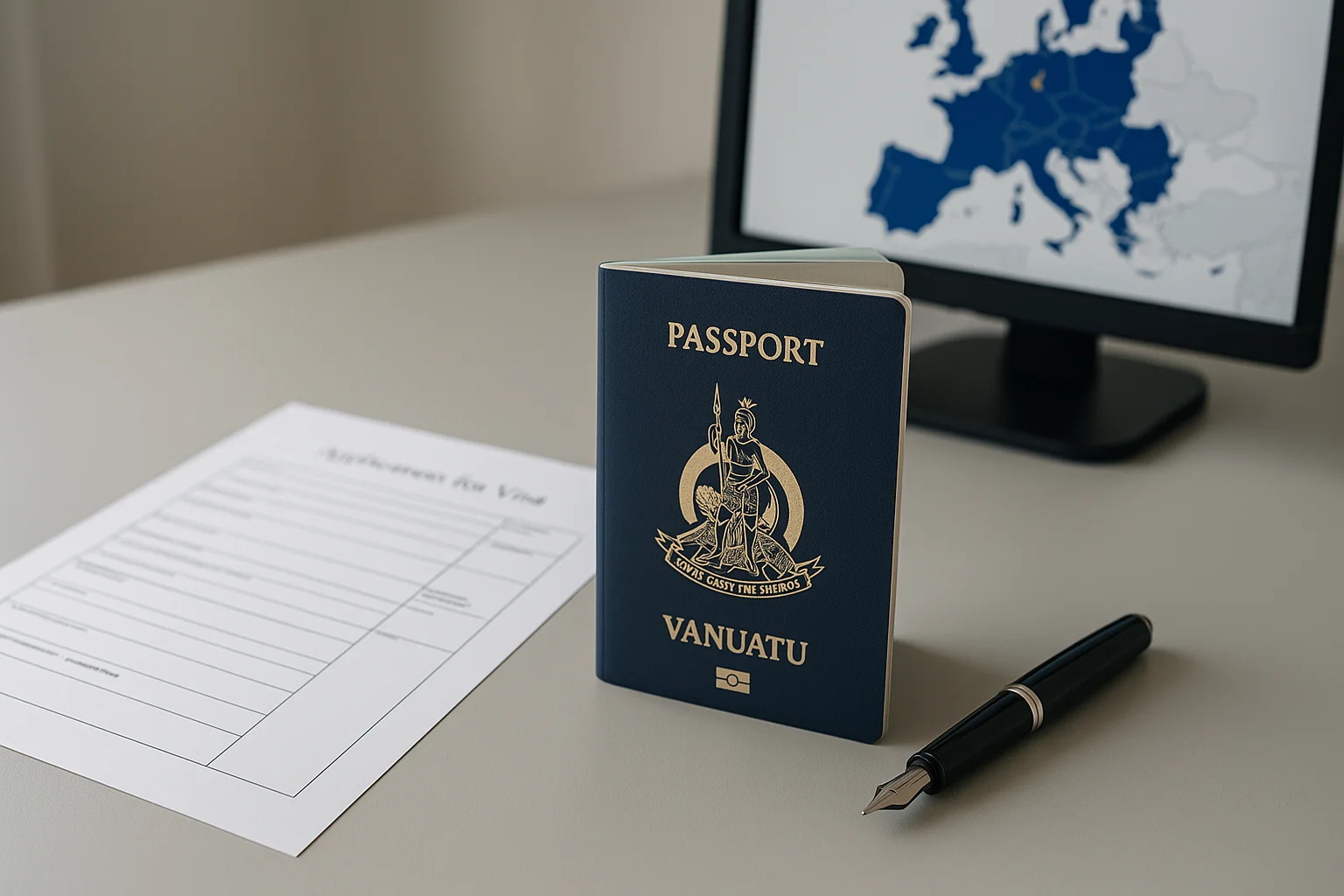
You can file your application up to six months before your travel date, but no later than 15 calendar days before you leave. Don't cut it that close. Processing times can vary, and hitting that 15-day minimum is a recipe for anxiety. Your first, most critical step is figuring out *where* to apply. You must submit your application to the consulate of your main destination—the country where you'll spend the most time. If your time is split equally, apply at the consulate of your first port of entry into the Schengen Area.
The process involves filling out an official form, gathering a pile of supporting documents, showing up for a biometric appointment (fingerprints and photo), and paying the visa fee.
Step 1: The Schengen Visa Application Form and Documents
A messy or incomplete application is the fastest way to get a visa rejection. Your file needs to be perfect.
Here are the documents you'll typically need:
- Your completed Application Form: Make sure it's filled out correctly, then signed and dated. Double-check everything.
- A valid Vanuatu Passport: This must be valid for at least three months *after* you plan to leave the Schengen Area. It also needs two blank pages for the visa sticker.
- Two Passport-Sized Photos: Must be recent and meet the strict ICAO standards (color, white background).
- Travel Medical Insurance: Your policy must cover at least €30,000 for the entire Schengen Area. It needs to cover emergency medical care, hospitalization, and repatriation. If your insurance is invalid, your application is dead on arrival.
- Proof of Accommodation: Confirmed hotel bookings for your whole stay or a formal invitation letter from a host in a Schengen country.
- Proof of Itinerary: You need flight reservations showing your entry and exit from the Schengen Area. Do not buy non-refundable tickets until the visa is actually in your passport.
- Proof of Financial Means: You must prove you can afford your trip. Bank statements from the last 3-6 months are the standard way to do this.
- Proof of Intent to Return to Vanuatu: This is a make-or-break document. The consulate needs to believe you won't overstay your visa. A letter from your employer, proof of property you own, or evidence of strong family ties back home are all good ways to prove this.
Step 2: Paying the Fees and Attending Your Appointment
With your documents ready, you'll need to book an appointment and pay the fees.
The standard Schengen visa fee is €90 for adults and drops to €45 for children between 6 and 12. Kids under 6 are free. You pay these fees when you submit your application.
Many consulates don't handle applications directly anymore. They use external service providers like VFS Global or TLScontact. If you go through one of these centers, expect to pay an extra service fee on top of the visa fee.
At your appointment, they'll collect your biometric data—all 10 fingerprints and a digital photo. This data gets stored in the Visa Information System (VIS) for 59 months. Good news: this means you likely won't have to provide biometrics again for other Schengen visa applications within that nearly five-year period.
Step 3: Awaiting the Decision and Understanding the Outcome
Once your application and biometrics are submitted, the waiting game begins. The standard processing time is 15 calendar days.
But that's not a guarantee. The consulate can extend this period to 45 days if they need to dig deeper into your file or ask for more documents. There are three possible outcomes:
- Visa Issued: Success. A visa sticker will be placed in your passport. Before you celebrate, check every detail on it: the validity dates, the number of entries (single, double, or multiple), and your maximum length of stay. A simple typo on the sticker could ruin your trip if you don't catch it.
- Request for More Information: The consulate might email or call you for extra documents or an interview. You must respond immediately. Delays on your part could lead to a refusal.
- Visa Refused: If your application is denied, you'll get a formal letter explaining why. You have the right to appeal based on the laws of the country that refused you. Or, you can fix the problems mentioned in the letter and submit a brand-new, stronger application.
What are the Benefits and Limitations of a Vanuatu Passport?
A passport's value comes from the mobility it offers. Its strength is measured by a "mobility score"—how many countries you can enter without a visa. In 2026, the Vanuatu passport has both real benefits and one huge limitation.

Losing visa-free access to the EU has tanked the passport's practical value and global ranking. For an international traveler, losing visa-free entry to 29 of the world's most popular countries is a massive drawback.
This is especially painful for those who got their passport through Vanuatu's Citizenship by Investment program. The EU's decision is a stark reminder of the risks involved with CBI schemes. It proves that visa-waiver deals are not permanent and can be ripped up if a country's security standards don't meet its partners' expectations.
What is the Vanuatu passport visa-free countries list?
Despite losing Schengen access, the Vanuatu passport is far from useless. It still offers visa-free or visa-on-arrival entry to over 88 other countries and territories worldwide. This provides a solid amount of travel freedom, particularly for trips within Asia and the Caribbean.
A few key destinations remain accessible without a prior visa. Think Hong Kong, Singapore, Russia, and the Philippines. Many nations in Africa, the Caribbean, and Oceania also offer visa-free entry or visa-on-arrival, but the list isn't static. International relations and visa policies can change with shocking speed. So, before you book a single flight, you must verify the latest entry rules with the embassy or consulate of your destination.
Vanuatu passport ranking
Several firms publish passport ranking indexes, scoring them on how many places a holder can visit without a pre-arranged visa. These rankings offer a quick, useful snapshot of a passport's relative power.
The Vanuatu passport's rank took a hit after the EU's decision—first a partial suspension, then a full one—of the visa waiver agreement. This drop shows just how much weight access to Europe carries in global mobility scores. If other major countries re-evaluate their own visa policies with Vanuatu, its ranking could fall even further.
How Do You Get a Vanuatu Passport?
You can become a citizen of the Republic of Vanuatu in a few ways: by being born there (jus soli), by descent (jus sanguinis), through naturalization after living there a long time, or by investment.
The last option gets all the attention. The Vanuatu Citizenship by Investment Program, officially the Development Support Program (DSP), allows foreign nationals to legally get citizenship and a passport. It requires a significant financial contribution to a government development fund. Established under the Citizenship Act [CAP 112], the program is designed to pull in foreign direct investment to build up the nation's economy and infrastructure.
Vanuatu passport price / How much does it cost to get a Vanuatu passport?
The main cost for a Vanuatu passport through the CBI program is a non-refundable contribution to the government's Development Support Program.
For one person, the minimum contribution is $130,000 USD. That number climbs if you want to include a spouse, children, or other dependents. On top of the contribution, you must also pay for mandatory due diligence checks—typically $5,000 USD—plus various application and agent fees. A key bit of context: since July 1, 2024, many Caribbean CBI programs hiked their minimum investment to $200,000, which has made Vanuatu's program look comparatively less expensive.
How to get Vanuatu passport
The entire process for getting a passport through Citizenship by Investment is handled exclusively by government-approved agents. You cannot apply directly. Here’s how it usually works:
- Engage an Authorized Agent: First, you must hire a "designated agent" officially authorized by the Vanuatu government. This is non-negotiable, as they are your only path into the system.
- Due Diligence Pre-check: The agent runs an initial background check. The real test comes next: if no red flags appear, your file goes to the government's Financial Intelligence Unit (FIU) for a deep-dive investigation. A minor, undeclared issue on your pre-check can become a major roadblock here, potentially causing your application to be rejected outright.
- Application Submission and Contribution: Once the FIU gives the green light, your agent submits the full citizenship application. After the Citizenship Commission grants an "approval in principle," you are required to make the full contribution.
- Oath of Allegiance and Passport Issuance: With payment confirmed, you must take an oath of allegiance. This can often be done remotely. Once the oath is taken and recorded, the Certificate of Citizenship is issued. This certificate is the document that finally allows you to apply for and receive your Vanuatu passport.
This article is published by an independent law firm for informational purposes only and does not represent or claim affiliation with any government body, international organization, or official authority.
Questions
Frequently Asked Questions
A: Yes. If you hold a Vanuatu passport, you must get a Schengen visa before traveling to the Schengen Area. This applies to any purpose, including tourism. The requirement has been fully in effect since February 4, 2025, after the complete suspension of the EU-Vanuatu visa waiver agreement.
A: Cruise ship passengers visiting Vanuatu for a single day stop usually don't need a visa; they're considered in transit. Still, this can depend on the specific policies of both the cruise line and Vanuatu's immigration officials. It's always best to confirm with your cruise operator before you sail.
A: As of 2026, the 29 countries of the European Schengen Area are off the visa-free list for Vanuatu passport holders. The passport does, however, still provide visa-free or visa-on-arrival access to over 88 other countries and territories. This includes places like Singapore, Hong Kong, Russia, and many nations across Asia, Africa, and the Caribbean.
A: To prove you have enough money for your trip, you need documents showing you can cover your expenses. This typically means submitting recent bank statements from the last 3-6 months. Other evidence might work, like a letter from your employer stating your salary or a formal sponsorship letter if someone else is paying for your travel. The required amount isn't fixed—it varies by country but is often a daily minimum, like €65–€120 per day. As a practical tip, always bring more proof than you think you need, as a consular officer has final discretion. A last-minute rejection for weak financia
Contact Us
Schedule Your Free Case Evaluation Today
Share the details of your situation with our team, and we'll provide a prompt, confidential response. We're here to listen, answer your questions, and help you understand your legal options.
Send Us a Message
Reach Us Directly
All consultations are strictly confidential and protected by legal professional privilege.